Two apples and an aching hand later, my analysis of “The Poison Tree” by William Blake was over. Its practically impossible to compete with the metaphor of the poison tree, but I would describe it as pushing an empty-tanked car to a gas station, only to be welcomed with 89 cent petrol.
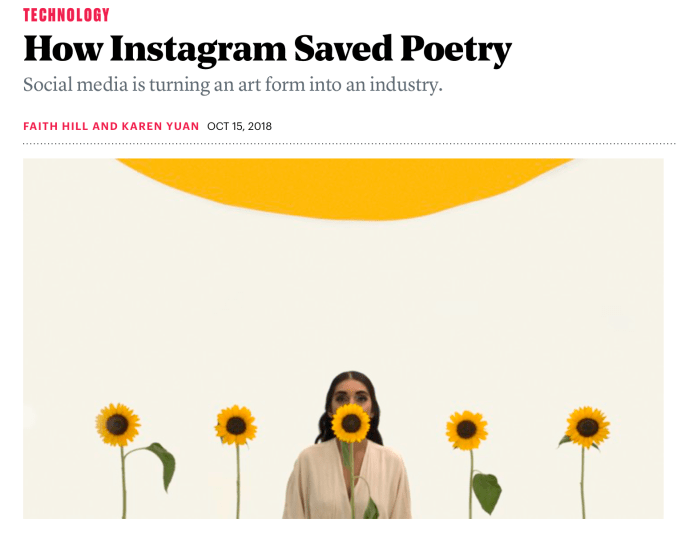
This blog is quite different from the previous, as rather than focusing on poetry itself, it instead focuses on how evolution has affected its distribution. An article written by The Atlantic called “How Instagram Saved Poetry” outlines that Instagram has welcomed ways to showcase written poetry profitably, encouraging careers, and therefore more writers. The article suggests that poetic writing was seen as an artistic hobby rather than occupation before Instagram “saved” it. The new evolution of poetry has begun to flourish online, allowing people to share their words more than ever before, but is Instagram really the one to thank?
Rupi Kaur is undeniably the trailblazer of mediated poetry and resembles a classic example of evolutionist poetry. She, unlike others, was able to build supplementary income off writing, publishing two of the most renowned poetry titles, ‘milk & honey’ and ‘the sun and her flowers’. Inevitably backlash was received as many argued that overly spaced, depressing words filling over one hundred pages isn’t and shouldn’t be called poetry. In my opinion, I believe, that like art, lifestyle or mechanics, they adapt to world changes. Fear will always be found where classics are at risk of loss, amongst the prominent change of literature and public distribution. Yet it must be reminded that classics don’t get their fame from being anyone’s grade six poetry assignment, they’re classics because they’ve left an impression in history. Poetry has and always will be influenced by the world’s development, inspired by none other than the O.G.’s themselves enabling poetry to be written anyway, anytime, anywhere.
The sharing platform has inspired more writers to use poetry as a creative outlet, to share their work amongst the social media community. Instagram, although bringing poetry onto a more familiar platform of distribution, isn’t the saviour of poetry, but rather the watering can that assisted a flower through a drought.

 Shayna Jahoots Takes On POETRY