Hey team! thanks for joining
To introduce myself, my name is Shanaya Juhasz and this blog is aimed to document the unit of extension poetry, inclusive of the humour, blood, sweat and tears 🙂
Have a good day my friend!
Shayna Jahoots Takes On POETRY
*hey pal, its your gal*
Hey team! thanks for joining
To introduce myself, my name is Shanaya Juhasz and this blog is aimed to document the unit of extension poetry, inclusive of the humour, blood, sweat and tears 🙂
Have a good day my friend!
As I awake to our first Aspire English lesson for semester two, I am pleasantly welcomed with the focus literature, poetry, or more specifically “why we turn to poetry in key moments of our lives”. To my English teachers’ dismay, poetry was always seen to me as a pretentious arrangement of words to express feelings rhythmically, in other words, a written musical involving poetic devices, syllables and nothing less than me frantically attempting to rhyme, workman and engine in a ballad. However, through the deconstruction of eras and poetic literature choices across these initial four weeks, my understanding of poetry has broken past these assumptions.
Step one was none other than poetry analysis, I aimed to work on highlighting and identifying techniques and writing comprehensively. Explaining and analysing poetry is a whole new level of thinking.
From this, four prominent eras were deconstructed, ours being Elizabethan… SHAKESPEARE. This era is dissimilar to the others and focused on a tragedy (e.g. World War 1, Victorian etc; used poetry to advocate knowledge or affection). The era was commended for embellishment of English literature, as well as its exploration and expansion of peace, which is often referred to as “the golden age” of English literature. We focused on key poets like William Shakespeare, Edmund Spencer, Thomas Campion also looking in-depth into Sonnet 18. Analysing how the extended metaphor of a summer day reflected on Shakespeare’s unrequited love for his mistress. Using other poetic elements like personification and rhyme to appeal to the audience he wrote for in ways they couldn’t explain.
The first four weeks of this unit have been very beneficial in setting both a pace and expectation of what to achieve over the terms to come. Am I 100% confident thus far? No, but I’m propitious that across the semester the idea of twenty-minute presentation and performing an original piece may warm in.
Entering the second quarter of the poetry unit only meant one thing, the performance criteria was making an appearance. As fun as it is to harshly critique slam poets, acting like the Simon Cowell of the judiciary board, when it came time to recite poetry of our own, I can wholeheartedly say it is nowhere near as easy as performers make it look. You see, a poem recited and a poem performed can dramatically affect the interpretation or purpose the poem is portraying by the change of pace, pitch or even gesture.
I discovered that when writing poetry I tend to make up my own… lets call it neologism.. and it became apparent that no matter how may wavy red lines Microsoft word beams in my face or how much of an anxiety attack grammar check, I felt that the software designed for writing was the one at fault. One example would have to be my protest poem written to protest against Liv protesting a protest poem, I’m going to say protest one more time: PROTEST! This genre of poetry really evoked how open poetry is to concepts and ideas, and how nearly impossible it is to match 4 syllables and rhyming consistently across three stanzas. It also showed an example of how pauses and accents on words of vowels can separate and enhance its purpose.
We were fortunate to have Simon Kindt, a standup poet, reiterate his reasons for poetry; suggesting it was a language for those who couldn’t simply express in standardised speech. Which was really fascinating, to say the least. He also taught us that poetry slams are more for advocation rather than competition, staging many ways the audience could be incorporated into the performance to enhance the meaning for example; closing your eyes and laying down. Simon Kindt also made a note of saying that when writing and presenting our own poems, how important it is to sell it to the audience, not necessarily theatrically but passionately.
Two apples and an aching hand later, my analysis of “The Poison Tree” by William Blake was over. Its practically impossible to compete with the metaphor of the poison tree, but I would describe it as pushing an empty-tanked car to a gas station, only to be welcomed with 89 cent petrol.
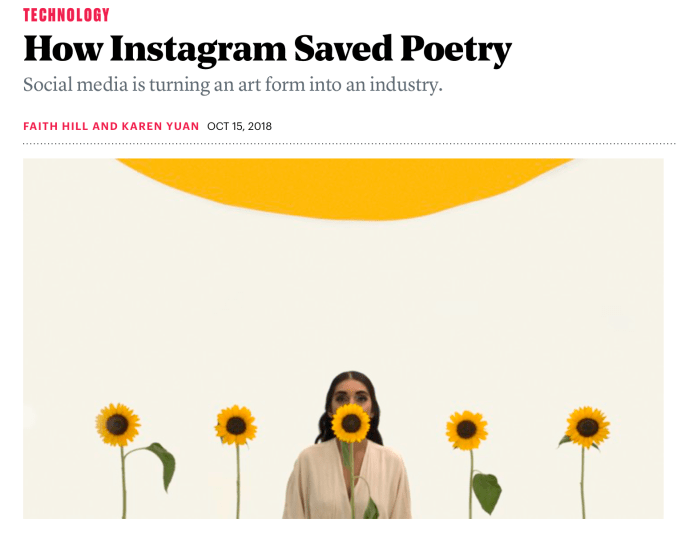
This blog is quite different from the previous, as rather than focusing on poetry itself, it instead focuses on how evolution has affected its distribution. An article written by The Atlantic called “How Instagram Saved Poetry” outlines that Instagram has welcomed ways to showcase written poetry profitably, encouraging careers, and therefore more writers. The article suggests that poetic writing was seen as an artistic hobby rather than occupation before Instagram “saved” it. The new evolution of poetry has begun to flourish online, allowing people to share their words more than ever before, but is Instagram really the one to thank?
Rupi Kaur is undeniably the trailblazer of mediated poetry and resembles a classic example of evolutionist poetry. She, unlike others, was able to build supplementary income off writing, publishing two of the most renowned poetry titles, ‘milk & honey’ and ‘the sun and her flowers’. Inevitably backlash was received as many argued that overly spaced, depressing words filling over one hundred pages isn’t and shouldn’t be called poetry. In my opinion, I believe, that like art, lifestyle or mechanics, they adapt to world changes. Fear will always be found where classics are at risk of loss, amongst the prominent change of literature and public distribution. Yet it must be reminded that classics don’t get their fame from being anyone’s grade six poetry assignment, they’re classics because they’ve left an impression in history. Poetry has and always will be influenced by the world’s development, inspired by none other than the O.G.’s themselves enabling poetry to be written anyway, anytime, anywhere.
The sharing platform has inspired more writers to use poetry as a creative outlet, to share their work amongst the social media community. Instagram, although bringing poetry onto a more familiar platform of distribution, isn’t the saviour of poetry, but rather the watering can that assisted a flower through a drought.
T-4 days till showtime, eek! This term has really been a solid grind, incorporating all the elements we’ve learnt, such as poetry writing, analysation, performing and so on, into one cohesive presentation. — I hope. My group, comprised of Liv, Zach and Oscar, has chosen the topic “redemption”, encompassing the four stages falling, fallen, rising and risen. Our approach to this task was and remains to be optimistic, and very much a ‘roll with the punches’ experience. To my surprise, our group managed to balance out our workload, due dates as well as the enjoyment of comprehending shower thoughts… Your bed is a shelf for your body when you’re not using it!!
During this term, I grew to appreciative a group of four as compared to fourteen, my stress levels weren’t visiting the moon nearly as much, if at all. I knew from the get-go that distractions and literally anything no matter how irrelevant would blossom into a twenty-minute conversation in our group. Therefore structuring our work ethic reliant on progress made in class wasn’t quite going to work. Instead, setting strict progression check-ins, meant members got to reflect on their completion and manage their time both in and out of class. If you chose to take it easy one lesson, which believe me after an advertisement campaign and minimal hours sleep was heaven on earth, it meant that you could do so as long as you met your mark by check-in. The success of this technique, despite its concern of being off task, sustained the enjoyment and engagement of the project throughout the entirety of the term.
I wouldn’t say I’ve completely warmed to the idea of presenting for 20 minutes, but the last two terms despite the countless tree metaphors and tedious analyses have prepared me both with confidence and understanding of poetry as a whole. The cooperation and respect the group had for each other is the real reason this project flowed so well. I wish future me the best of luck and worst comes to worst everyone in our group minus Liv, is quite loud and slightly obnoxious, what more could an audience ask for?. Clear your calendars folks, Thursday, November 22nd, be there or be square.
 Shayna Jahoots Takes On POETRY